
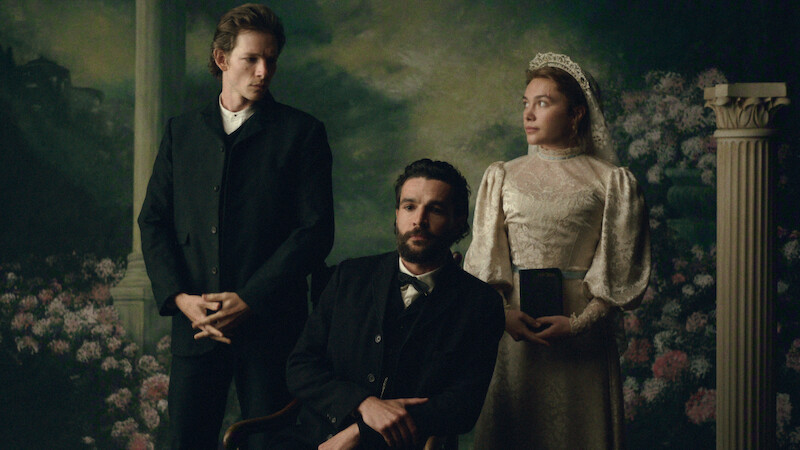
A good adaptation does not owe a novel its every word. It owes the story an understanding of what makes it worth telling. Netflix’s “East of Eden” takes liberties with John Steinbeck’s classic, but its biggest departure is also one of its greatest strengths.
The limited series follows the Trask family across generations, beginning with brothers Adam (Christopher Abbott) and Charles (Mike Faist) in Connecticut before following Adam to California with Cathy Ames (Florence Pugh).
Their twin sons, Cal (Joseph Zada) and Aron (Joe Anders), inherit a family legacy built on deception, setting the stage for a retelling of the biblical story of Cain and Abel.
Through both generations, the series explores inherited sin and the question at the heart of Steinbeck’s novel: Are people born evil, or do they choose to become so?
The answer lies in timshel, a Hebrew word central to Steinbeck’s novel that means “thou mayest.” People have the choice to overcome evil rather than remain bound by it.
The series builds on this idea, but its biggest departure is Cathy. Under Zoe Kazan’s writing, she is given something Steinbeck’s characterization largely denies her: a reason for her wickedness.
Kazan does not make Cathy any less wicked, nor does she ask the audience to forgive her. She simply makes her more human. Under Steinbeck, Cathy’s motivations are largely ambiguous, making her wickedness feel innate.
Kazan gives her something more unsettling: the capacity to be kind, and the conscious decision not to be. Cathy isn’t evil because she has no other option. She is evil despite having one.
Kazan’s Cathy would not be nearly as effective without Florence Pugh, who brings her vision to life with a mesmerizing, almost unnerving prowess. Pugh makes even Cathy’s most unsettling impulses impossible to look away from, giving the character a presence that is as captivating as it is disturbing.
The rest of the cast deserves just as much praise. Hoon Lee, as Lee, is the story’s beating heart, bringing warmth, wisdom and humanity to a family that desperately needs all three. His presence gives the story some much-needed tenderness without diminishing the tragedy surrounding him or the struggles he faces himself.
Joseph Zada is equally outstanding as Cal, capturing the desperation of a young man who wants so badly to be loved. His performance is devastating, making Cal’s longing feel painfully real.
Meanwhile, Faist delivers a different kind of heartbreak as Charles. His jealousy and explosive temper can make him cruel, but Faist never lets those qualities define him entirely. Beneath the rage is a lonely man who desperately misses his brother.
The ensemble gives nearly every character room to shine, making it difficult to hate any one of them, even when their actions are indefensible.
Visually, the series is less consistent. The colors occasionally fall flat, and the dark tones leave little visual interest to hold the viewer’s attention.
The minimal camera movement can also leave scenes feeling static. Still, the dreary atmosphere effectively captures the story’s somberness, and these flaws rarely overshadow the actors’ performances.
The bigger issue is pacing. By giving Cathy’s character the attention needed to establish her motivations, the series sacrifices opportunities to develop other characters, including scenes involving most of the Hamilton family and Adam’s relationship with his stepmother.
There is also the fact that Cal and Aron arrive too late. The grown twins don’t appear until the second-to-last episode, leaving little time to establish who they are and why Cal loves Aron so fiercely.
Aron, especially, remains difficult to understand. One more episode could have given the brothers the development they deserved.
Still, it is hard to call this a bad adaptation when the biggest complaint is that there wasn’t enough of it.
Kazan’s version preserves the beauty of Steinbeck’s story without the help of his prose, which is no small feat. It may not be a completely faithful replica of the novel, but it is arguably the necessary version this story needs now.
By giving Cathy a choice, Kazan reinforces the idea at the heart of “East of Eden”: No one is condemned to evil simply because they have suffered, and no one is incapable of good because they have done wrong.
In 2026, a story that insists people can choose goodness is more meaningful than one that treats evil as an inescapable part of human nature.