
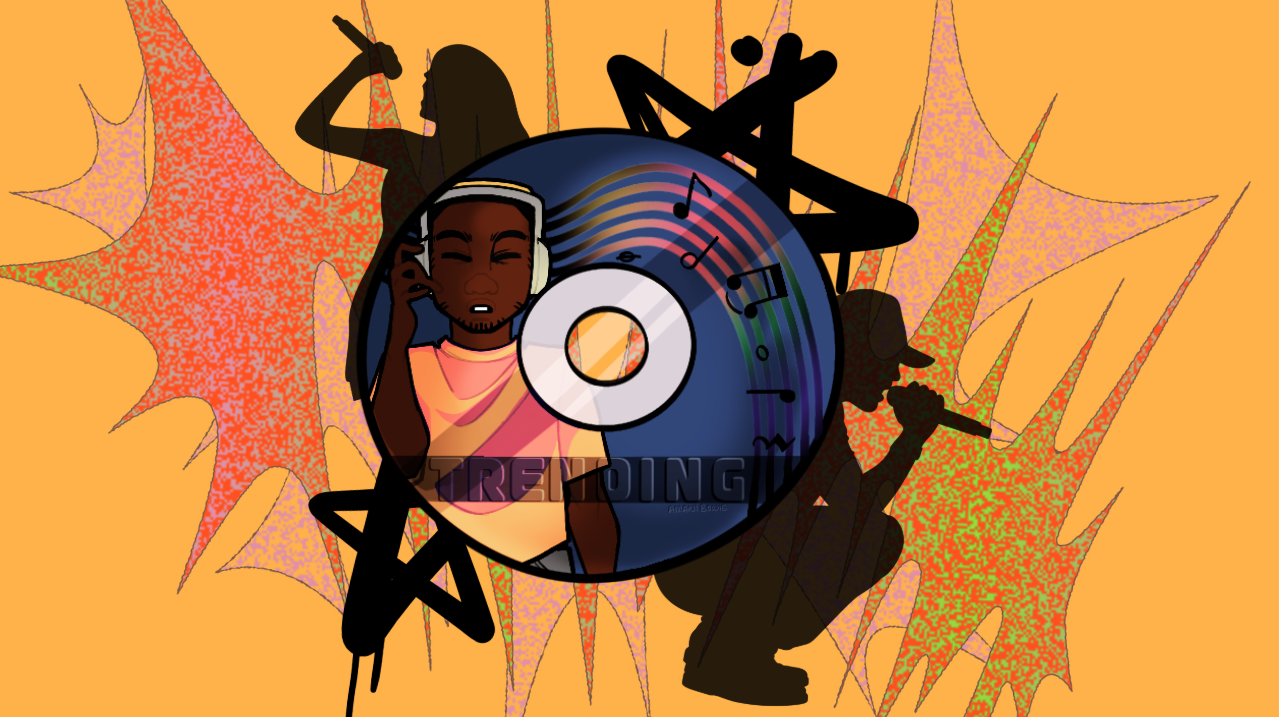
Illustration by Amani Bowie
Hip-hop became the most successful genre in the mid-late 2010s with the rise of trap and melodic/emo rap. But now, it feels like hip-hop’s stardom is slowly descending when it comes to surviving through mainstream exposure.
We definitely can’t forget their names: Kanye, Lil Wayne, Drake and Nicki Minaj. Despite having made pivotal, genre-shaping music, rappers from the 2000s and early 2010s are slowly starting to fade away.
The era of a “Big 3” defining a genre is disappearing. Hip-hop and R&B songs aren’t charting like they once were. All we get are a few songs on mainstream radio stations by already-known artists. Even then, the prestige of being played on the radio has been dying out for a minute.
If we’re talking about genres not just surviving but thriving, what about streaming? To me, it seems that artists are just phoning in a lot of their albums, dropping truckloads of songs into an “album” to boost their streams.
To actually preserve a music genre, I think we need to prioritize the art of album-making. It creates a world that immerses you into the heart of the project.
A lot of young people will not even listen to full albums anymore. We just hit shuffle or listen to the features. In most cases, we will not listen to an album in its entirety unless it’s from our favorite artist.
Now when it comes to hip-hop, I want to see people make immersive rollouts, genre-bend and go out of their comfort zone. Strong musicians are people whose music can evolve over time, whose sound is not the same with every album.
Tyler, the Creator, for example, dropped a dance album last year. Lil Uzi is experimenting with rock and jersey club. Baby Keem is mixing west coast hip-hop with trap, R&B and alt pop on his newest album “Casino”. We also have Playboi Carti, who is bringing back 2000s trap mixtape aesthetics on his newest album “Music”.
These are current, mainstream artists that move the goalpost of what hip-hop albums can sound like. We need those artists to carry us now.
So, what’s to say about the names that are not yet widely-known, or the “underground”? At the moment, I really enjoy Slayr for his fun, vibrant mix of rage and electronic, and UK rapper Esdeekid, who has hard-hitting production. You could say lyricism is not at an all-time high right now, but hope is not lost with rappers like Chris Patrick, Redveil, as well as Joey Valance, Brae and Quadeca who mix in genres like punk, dance music, alternative pop, and folk into hip-hop in their own way.
Overall, there’s a lot of people in hip-hop giving you good work. You just have to look out for it. Now, what about R&B?
R&B is in a really weird place. I don’t think it really knows where it’s at right now and there’ s a few reasons why that is. Firstly, there is not a lot of high level vocalists that are usually present on these tracks. It’s trying too hard to be hip-hop. More often than not, the production is too dark/minimal. Finally, a lot of the lyrics push toxicity when it comes to love and relationships.
All of this really ties into the fact that the genre is trying too hard to be hip-hop. R&B and hip-hop, especially in the 90s-2000s, have always been heavily tied to each other. They always felt separate but connected when it came to the sounds and content matter.
So why we are seeing this? I think this is mainly due to the dark R&B “trapsoul” era of the early 2010s. Music like the Weeknd’s trilogy and PartyNextDoor paved the way for this new sound, which contrasts the “yearning” theme R&B traditionally has.
When you do get different sounding R&B, usually it’s from artists are not really “R&B” but more so pop/alternative like SZA, Teezo Touchdown, Laila!, Steve Lacy and Malcolm Todd. Even Kaytranada, who collaborates with a lot of R&B artists, is more dance/house music than anything.
A lot of R&B music is banking on non-R&B production. And it really feels like it’s shortchanging its true range. We need a new R&B sound, like how “New Jack Swing” was used in the late 80s-90s. Maybe we bring that sound back with a “new swing” to it (wink).
There’s not a lot of pop artists that I really like nor feel particularly strongly about, even Olivia Rodrigo, Sabrina Carpenter or Billie Eilish who are practically superstars at this point. And if you compare recent pop hits “Lose Control” by Teddy Swims, “Bar Song” by Shaboozey or any Morgan Wallen song, they barely match the quality and popularity of 2010s pop songs like a “Lights” by Ellie Goulding, “We Are Young” by Fun. or “California Girls” by Katy Perry.
My lack of confidence comes from the fact that many of these songs are not really played worldwide. If you hear a song played truly everywhere, then it feels like a hit (because it is), not a trending Instagram Reels song. And I think this goes back to my thoughts on radio not being the “exposure standard” for new, promising music.
A lot of what we see across genres comes down to one thing: monoculture is dying out.
We don’t get superstars like Michael Jackson or Beyonce anymore because everyone moves on quickly with social media feeding us so much through our algorithms. Bruno Mars made an album this year, but it feels like no one is talking about it. This would not have been the case at all in 2016, where you couldn’t go two days without hearing one of Bruno’s songs somewhere.
You can say this is just nostalgia speaking, but mainstream music is starting to become irrelevant. And to counter this, we need to seek out different-sounding music.
Do not listen to what algorithms, labels, radio/streaming playlists are saying. Instead, take a recommendation or two from somewhere else, like an opinion article, for instance.