
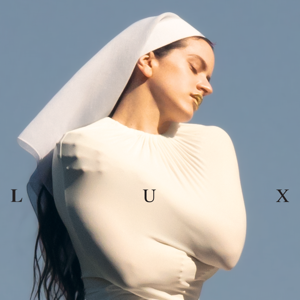
Singer/songwriter Rosalia has returned triumphantly with her fourth studio album, Lux. Announced a little less than two weeks before its release, with the hit single ‘Berghain” featuring Björk and Yves Tumor, the album promised an entirely new world for fans to dive into.
Coming three years after her Grammy-winning record “Motomami” which she described as ‘minimalist’ in an interview with Zane Lowe for Apple Music, Lux and its maximalist approach explore her world of romance, study and questioning all there is. The album cover features the vocalist dressed as a nun, holding herself in her own arms, lips shining gold, reflecting the spiritual yearning that is reflected in the songs.
Sonically, the album is rich in classical sounds, infused with experimental breakdowns and modern electronic that balances its refreshing take on pop perfectly—recorded with the London Symphony Orchestra, featuring collaborations from Björk, Carminho, Estrella Monte, Silvia Perez Cruz, Yahirtza y su Esencia and Yves Tumor, and production from Noah Goldstien and Pharrell Williams.
Arranged in four movements, with physical versions featuring three additional tracks, Lux thrives in its orchestral and chamber pop habitat, taking us back to the basics of music while modernizing it.
To add to the already unique take, the album is sung in fourteen different languages: the singer’s native Catalan and Spanish tongue, as well as Arabic, English, French, German, Hebrew, Italian, Japanese, Latin, Mandarin, Portuguese, Sicilian and Ukrainian. Starting small with Google Translate, some tracks took an entire year to fully translate, with the artist consulting professionals to make sure her writing made sense.
Throughout the 18 tracks, each one finds the singer questioning herself, following themes of romantic relationships, connections to God and spirituality, transformation, life and death. Crafted over three years, personal experiences— such as a past relationship with singer Rauw Alejandro, as well as previous collaborations with artists like Björk and Blackpink’s Lisa— set the stage for “Lux.”
The opening track, “Sexo, Violencia y Llantas,” begins with soft, beautiful piano notes, signaling the orchestral theme of the project. Rosalia asks, “Quien pudiera vivir entre los dos, Primero amare el mundo, Y luego amare a Dios,” which translates to “How nice it’d be, to live between them both, first I’ll love the world, then I’ll love God.”
The following track “Reliquia” carries the listener into the next up-tempo songs as the singer tells her audience, “But my heart’s never been my own, I always hand it out.” Lux stands for light in Latin, and is most prominent in tracks like “Divinize,” in which Rosalia says, “Through my body you can see the light, Bruise me up I’ll eat all of my pride, I know that I was made to divinize.”
The lead single “Berghain” serves as the perfect introduction for an album of this caliber, assaulting its listeners with a powerful chorus of voices chanting in German, saying, “His fear is my fear, His rage is my rage, His love is my love, His blood is my blood.” Rosalia acknowledges them, singing, “I know full well what I am, Sweetness for your coffee… when you come here, that’s when I take off.”
The chorus of voices continues until Björk’s voice cuts in, saying, “The only way to save us is through divine intervention.” The track’s gruesome ending, featuring Yves Tumor’s voice, leaves you wondering whether or not she has truly found herself yet, spiritually or divinely.
The album’s latter half relaxes after the excitement of “Berghain,” with standout tracks like “La Perla,” in which Rosalia sings of a man who wronged her, calling him a “Local fiasco, National heartbreaker, Emotional terrorist” and “World-class f*** up.”
Tracks like “De Madruga” and “La Rumba Del Perdon” see the singer channeling traditional Spanish-style folk music like flamenco, cleverly incorporating modern bass and acoustic elements to retain a fresh yet classical sound.
The closing track “Magnolias,” finds her wishing for a celebration instead of mourning when she reaches death, singing, “Throw me magnolias, Over my casket… When God descends, I ascend.” Gone is the confusion of humanness and the divine, and yet, you are left to wonder, “Where did all the light go?”
An album that calls for multiple revisits, each listen will allow the listener to discover something new and better feel the light that is Lux. Rosalia’s magnum opus of an album is a gift to this world and one for its fans to cherish, reminding them to find their own light amidst all of the chaos.