
This semester, the Finley Gallery displayed a multimedia exhibition culmination of six weeks of work by visual arts students in the Integrative Studio course.
The Integrative Studio II (ISII) Student-Led Exhibition was a joint effort led by students of two classes instructed by professors Jess Blaustein and Genevieve Lowe.
The exhibition, which was on display from March 3 to March 17 in the Finley Gallery, spanned two subtitles which reflected the direction of the individual classes: Blaustein’s From the Outside In, and Lowe’s Divergence of Reactions. Despite the differing themes, the students coordinated together to organize the exhibition themselves.
The works spanned a range of forms, from sculpture to photography to quilting. General themes tended to include deconstruction, reconstruction and transformation, with several pieces highlighting culture and identity.
The ISII Student-Led Exhibition was entirely curated by the students of the two courses. The artists were challenged with organizing the exhibition spatially, physically constructing their works in the space, and coordinating the position of the pieces with an emphasis on keeping pieces with similar themes together.
The professors of the courses provided the students with a unique point of reflection to begin their work: the piñata. While it is only physically visible in some of the pieces, it demonstrates the classes’ ability to work from the same starting point and still create an entirely self-expressive end product.
The pieces were distinct and reflected the individual voices of each student, with each telling their own captivating story through both visual and auditory experiences.
Senior visual arts major Jenny Hernandez, a student in Blaustein’s course, referenced her El Salvadoran heritage in her piece, Warrior of My Homeland: Roots of Steel.
“My artwork shows the culture of my country, and my own personal culture,” Hernandez said, pointing out several symbols embedded in the painting that are nods to El Salvador, like the Torogoz, the country’s national bird, perched on the warrior’s arm.
The piece, which uses blue, red and green colors inspired by traditional Salvadoran folk art, is both a tribute to Hernandez’s culture and childhood, with the warrior representing a symbolic boundary and the tension between El Salvador and the United States.
Hernandez also explained the organization of the exhibition, where the students led the curation of the gallery.
“Some of [my classmates] and I made some peaceful scenes that kind of all work together,” Hernandez a.
Next to Hernandez’s work is a piece that ties together the peaceful, cultural theme she referenced: Mi Orgullo by Yanilda Munoz.
Mi Orgullo (My Pride) is a multimedia piece which both pays tribute to Puerto Rico and warns against a danger affecting thousands of residents: the disenfranchisement of native Puerto Ricans through the housing system.
Featuring a dioramic representation of her aunt’s house— which represents a haven from the recent trend of locals renting out their homes to tourists— the piece also consists of a collage made by Munoz of photos she took on a recent trip to the island. Next to the two visual elements is a webpage of AirBNB listings in Puerto Rico.
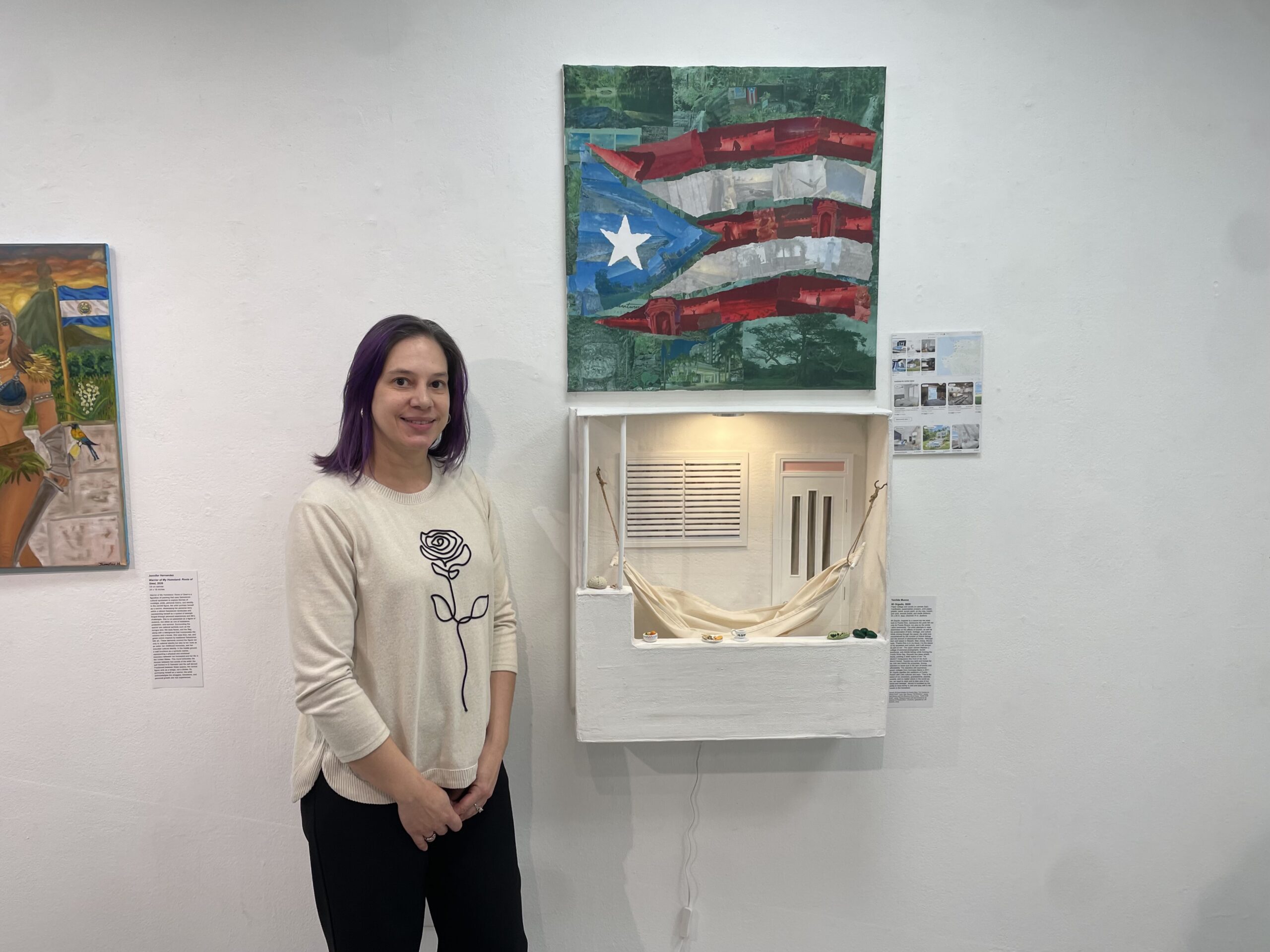
Senior visual arts major Yanilda Munoz with her piece, "Mi Orgullo" ("My Pride").
Rob Ferguson | The Montclarion
“When I was traveling in Puerto Rico… I spoke with a resident there, and they were saying that there are so many people that just AirBNB their homes that it’s hard for the islanders to actually find places to live,” Munoz said. “They’re forced to move away from their [homes] because of tourism.”
After the trip to Puerto Rico, Munoz had accumulated a number of photos that she used to create the collage, which makes the territory’s flag. From there, the concept moved to the diorama portion, which shows her aunt’s home in Puerto Rico.
“This is a replica of my aunt’s house,” Munoz explained. “She could easily AirBNB it if she wanted to, but she’s keeping it in the family… whenever anyone comes, [they] have a place to stay.”
With the bird sounds and Puerto Rican music playing from a speaker attached to the piece, Munoz’s goal was to convey the island’s intoxicating atmosphere.
“I wanted to bring the viewer into the island without being on the island,” Munoz said.
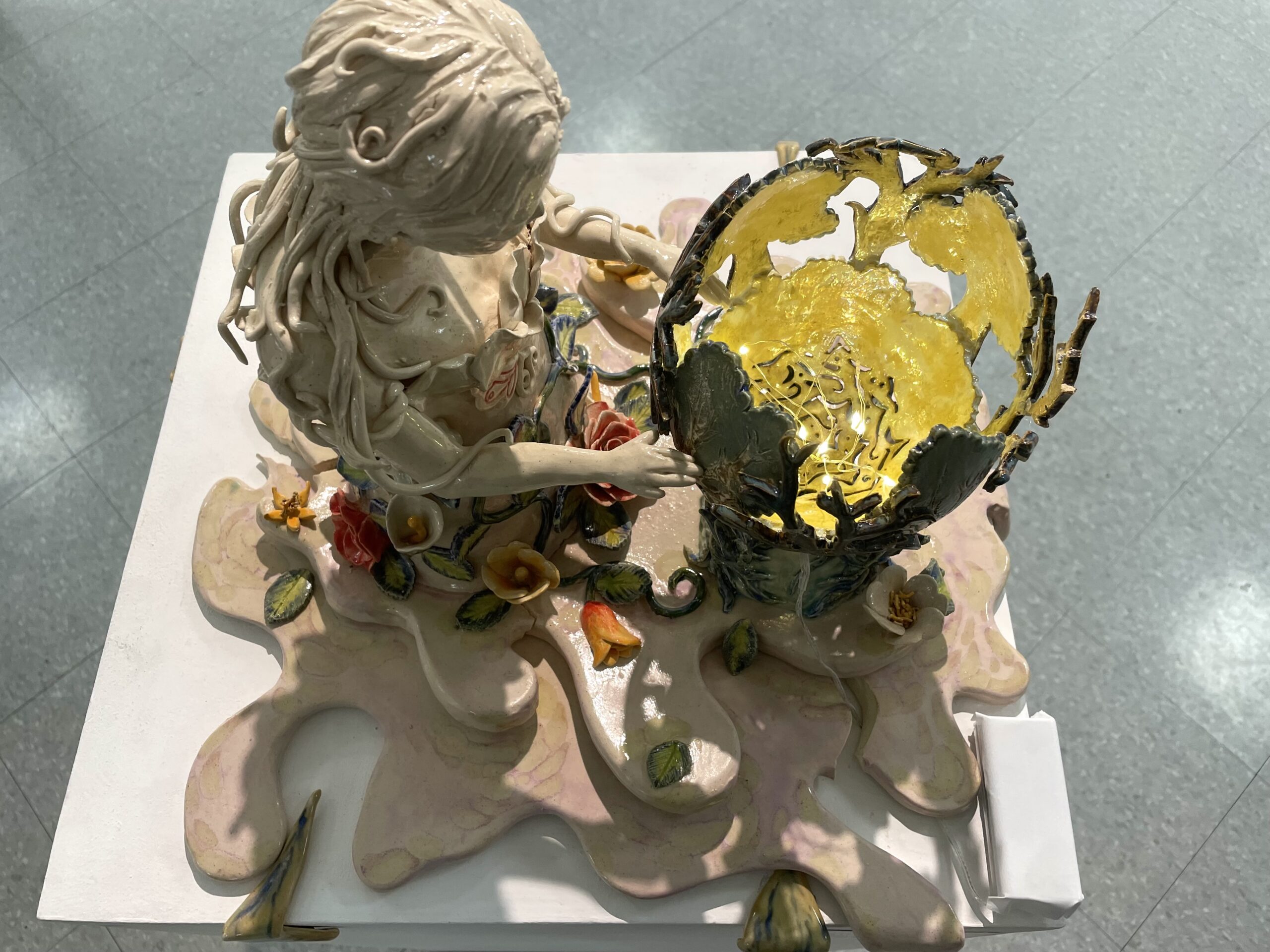
"Worldly Femina," by Emily Carrasco Perez, features a character inspired by Pachamama, the Peruvian equivalent of Mother Earth.
Rob Ferguson | The Montclarion
Worldly Femina by Emily Carrasco Perez, a senior visual arts major with a concentrating in education, is a piece that celebrates Peruvian culture while highlighting environmental themes.
The piece, which features ceramic pottery painted with elegant detail, shows a Peruvian deity, Pachamama— the country’s equivalent of Mother Earth. A common tradition in Peru is to have a unique ritual for the goddess. For Perez, that ritual is reusing organic matter, which helped inspire the sculpted piece.
“I came to school four days in a row, [working] from morning to night,” Perez, a student in Blaustein’s course, said about the hard work that went into the project.
Perez used the assignment as the opportunity to tell a story of the world coming to an end and melting away while Pachamama brings balance to it.
The students’ works, as well as their collaboration in curating the exhibition, speak to the themes of culture, identity and self that are present in the showcase, while also displaying the talent in the visual arts department at Montclair State University.
Professor Jess Blaustein was one of the two instructors who led the classes in the exhibition. The experience setting up their own exhibition, she said, proved to be very valuable in the artists’ journeys.
“One of the reasons I love teaching Integrative Studio II in the Visual Arts department is that exhibition making is a fundamental part of the class curriculum,” Blaustein said. “For most of my students, it is the first time they have a chance to move beyond creating their individual artworks to collectively creating an exhibition of their works to share with the broader public.”
For the professors, it is undoubtedly rewarding to see the creative expression of their students embodied in their works and appreciated by the community.
“I have a very talented group this semester, and I expected their final artworks to be rigorous,” Blaustein said. “I think what surprised me, though, was the emotional power and intensity of so many of their works. They took risks, and I’m proud of them.”