
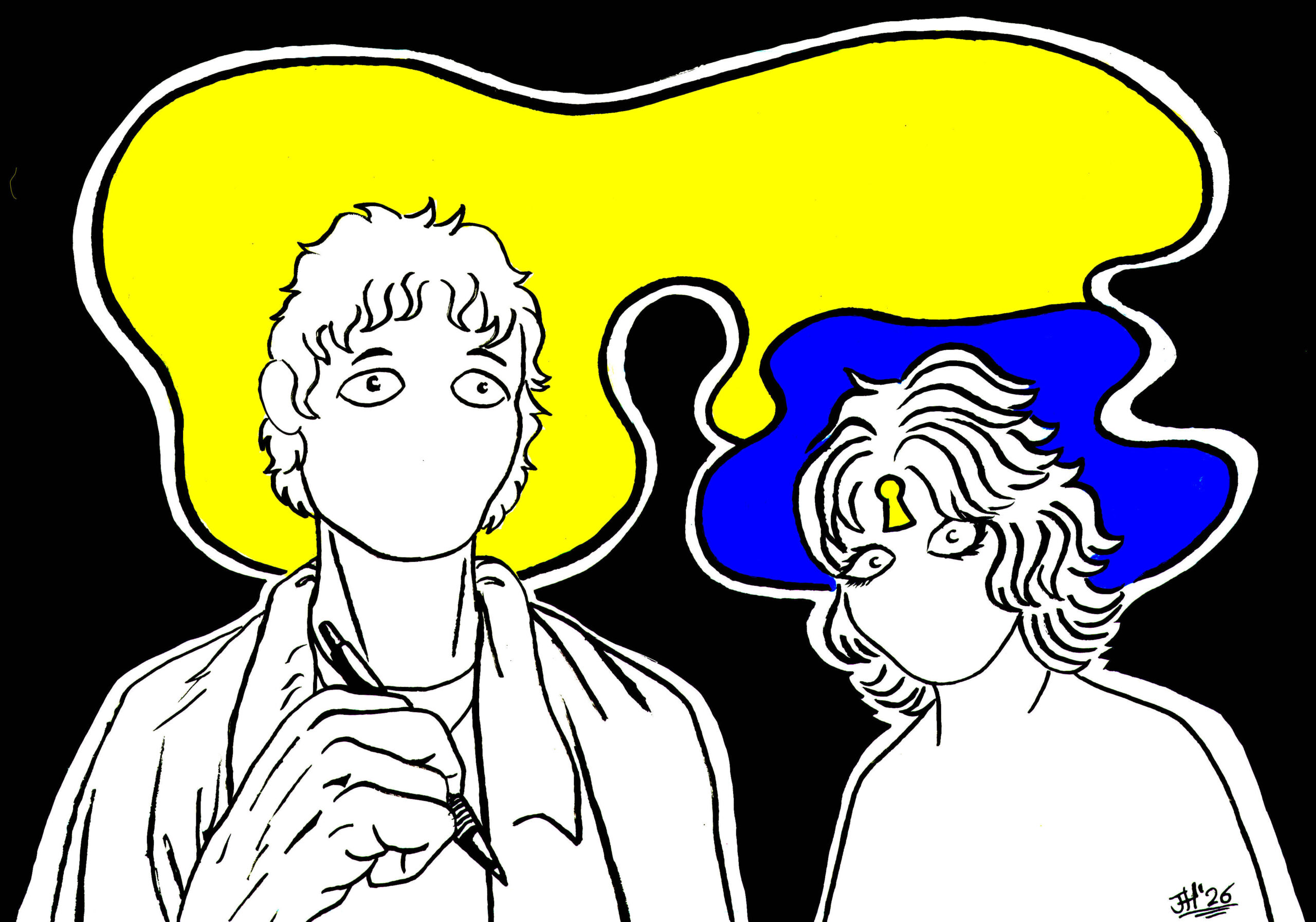
Illustration by James Hagan
“Sorry,” Madeline says, sitting down. “I forgot where I put my house keys, took forever to find them.”
Clive nods. It’s their first date, the one he doesn’t really want to be on, so he doesn’t mind the wait. He accepts her excuse, admitting once again that he isn’t like other people.
He never forgets.
He places himself briefly in Madeline’s shoes, imagining what it’s like to misplace something in your own house. Sometimes, Clive amuses himself with this little game: he hides his credit card in a random book, his keys in the kitchen drawer, his lighter in the laundry room.
But every morning, mechanically, he knows exactly where to find them: he recalls the exact page number where he had stashed the card, he knows what he wore at that moment and the time on his watch when he thought of a hiding place that was sure to elude him.
Not even halfway through the date, Clive confesses his strangeness, his condition, wanting to move past wondering questions and weird looks.
“You’re lucky,” Madeline tells him. “I wish I had a memory like that. It’s a blessing.”
“Blessing,” Clive snickers. “More like a curse.”
She pivots immediately after that and he’s grateful. Madeline asks him questions about life and work, but he can sense a shift in her now, although unlike the one he usually inspires. She’s curious, studying. Clive stirs under her attention.
It’s only after she turns, examining the restaurant, that Clive allows himself a moment of unguarded observation and, immediately, appreciation. He doesn’t want to remember the slope of her neck, her long lashes, her brown hair pulled into a twist, the sound of her voice — more timid than he had expected — or her jasmine perfume. But already he knows that these things are ingrained in his memory, like carvings in the trunk of a young oak, growing ever noticeable with time.
By the end of the first hour, he likes her. By the end of the second, after she suggests swapping the overpriced restaurant for an ice cream shop, the feeling intensifies. Yet he can’t ask for a second date: Clive remembers, with a shudder, how depressing his weeks were after his last break-up.
As if it happened seconds ago, he recalls exactly what he felt, vowing to never make the same mistake. He can’t date someone he really likes, someone whose absence splits his heart in half, whose every habit, every smile, every joke haunts him for the rest of his life.
So, when he walks Madeline to the bus stop, he says nothing, knowing that this is where they part.
“I had a very nice time,” she smiles.
There, under the streetlamp, Clive watches the dazzling light reflected in her eyes. It will take him a while to get over her. Time heals, people say. Well, time is not as kind to Clive. It only makes every moment, every memory, every word clearer.
“Here,” she says hurriedly, as if she just remembered. “Write down your name.”
She pulls a pen out of her bag and rolls her jacket sleeve up. Clive looks at her, puzzled.
Is it possible that she has already forgotten his name?
Still, he holds her wrist, carefully spelling his name across her skin. And before he can even return the pen, Madeline dashes towards her bus.
Clive has to forget her now. He doesn’t know how, but he’ll try.
For days, nothing happens. Clive tries not to dwell on the date as if it would make the memory fade. That’s how it works for others, he thinks to himself. Millions of ordinary moments pass in front of them and all they have to do is pluck out the important ones, the ones they’d like to revisit.
Clive doesn’t distinguish them. He can walk into any random day inside the chamber of his mind. Nothing special stands out.
It’s this way at least, until Clive sees her in the grocery store. Madeline stands in the vegetable aisle, reading the label on packaged tomatoes and Clive feels every bit of air hollow out of his lungs.
Uncertain at first, he decides to at least say hi.
But when he calls her name and their eyes meet, there is no flicker of recognition in hers.
“I’m sorry,” she says, placing the tomatoes in her cart. “How do I know you?”
He halts. The question sounds so genuine and unsure that Clive is confused rather than insulted. It has only been three days, he thinks. He doesn’t know much about forgetting, but certainly it’s not enough to erase any memory of him from her mind.
“Are you serious?” he asks, but nothing changes in her face. Madeline shrinks away, her posture both guarded and uneasy.
“It’s Clive,” he reintroduces himself. “You really don’t remember me?”
“Clive,” she repeats, wide-eyed. Suddenly, there is relief, apprehension, and oddly, traces of joy in her expression, like a kid slowly unwrapping their Christmas present, glimpsing what’s inside.
Her shirt covers her arms, but when she lifts her sleeve, there it is, his name, still in his handwriting, but retraced with a fading marker. Underneath, in small letters, it reads,
“Please remember him.”
He looks back at her, understanding surging in like a powerful tide.
He wants to laugh at the asymmetry of their situation. Two sides of the same coin. Two parallel lines that should never cross but somehow find a way.
Clive vaguely suspects that this might never work out. She will forget him every day, and she’ll keep forgetting him, no matter what he does to remind her.
Yet isn’t there something exceptional in that? A million special moments, each one a new introduction, never the same.
He thinks that it is indeed a blessing, to have already memorized every line of her face, to be able to hold it in his head with such precision.
“So, you’re Clive,” Madeline says, grinning now. “I finally found you. It’s nice to meet you.”
A blessing, not a curse.