
Editor’s Note: The Montclarion updated this article as the story continues to unfold. Visit our website for more coverage on the restructuring.
Montclair State University plans to move forward with restructuring the College of Humanities and Social Sciences (CHSS), a plan that involves eliminating departments and consolidating academic programs into four schools. This move has alarmed many among the campus community, sparking widespread opposition to the restructuring.
A petition titled “Montclair State Is Eliminating All Humanities Departments” quickly circulated across the community, garnering over 2,600 signatures. The petition outlines students’ concerns about the dissolution of the CHSS departments, which serve more than 5,000 students.
Supporters of the petition argue that eliminating the departments could weaken academic oversight, reduce student access to specialized mentorship and diminish the university’s commitment to literacy and social sciences. Jazmin Perez, a senior English major and creator of the petition, is alarmed by how restructuring would drastically alter the way the CHSS operates.
“It’s the dissolving of the departments that is the biggest concern,” Perez told The Montclarion. “[The administration] wants to eradicate department leadership in the replacement of bloated [structures]. Do not dissolve our departments, [don’t] get rid of department leadership and keep faculty autonomy in curriculum and scheduling.”
Under the new model, departments and department chairs will be eliminated and replaced with four schools. The programs will be contained in the new schools and grouped based on their disciplines: human behavior and well-being, civic and social systems, human narratives and creative expressions and interdisciplinary programs and writing studies. The official name of each school is yet to be determined.
The current departments in the CHSS would be reallocated into an appropriate school under the new model. For example, the English department would move to the human narratives and creative expressions school.
In addition to the four new schools, the college will include institutes and centers. The institutes are issue-based for research and scholarship purposes. Centers emphasize community engagement and highlight the college’s areas of research strength.
According to the university, restructuring is intended to enhance student success, maximize faculty impact and ensure the vitality of every academic program. Through this restructuring, its goal is to increase collaboration across disciplines, attract diverse faculty pools and improve equity for student success.
The administration also says the plan will increase access to full-time faculty and improve mentorship, while a unified scheduling system will improve student alignment with courses. Dr. Fatma Mili, the interim dean of the CHSS, explained the restructuring’s benefits for students.
“We will build the infrastructure to design schedules that better meet students’ needs, interests and progress towards graduation,” Dean Mili told The Montclarion. “Instead of 15 schedules built independently and then merged, we will integrate expertise from chairs and preferences from faculty with data around students’ demands, needs and success.”
The university will elect implementation committees to begin the restructuring process in January 2026, with a goal of transitioning to the new structure by July 2026.
Current department chairs will remain full-time faculty. The university have not yet identified the leader of each school.
The administration clarified that students will still be able to graduate with their selected majors, but only made that assurance to current students. When asked whether this leaves the future of certain CHSS majors in the air, Dean Mili denied those rumors.
“There is no plan to cut anything as part of or as a consequence of the restructuring,” said Dean Mili. “…We aim to strengthen existing disciplines and their programs and to add more programs and pathways that increase interest in disciplines that have been declining.”
In an effort to maintain transparency, the university conducted two student and four faculty surveys as well as several faculty meetings and forums since March, allowing faculty to give input and shared governance.
Still, CHSS faculty are skeptical about the restructuring. Jeremy Lopez, the English department chair, shares his colleagues’ concerns about losing disciplinary identity and oversight.
“The faculty response to the restructuring is characterized by broad agreement that we would like disciplinary integrity to continue to be foundational to our work as faculty,” said Professor Lopez.
Montclair State’s faculty union, American Federation of Teachers Local 1904, also expressed concerns about eliminating department chairs, emphasizing the role they play in students’ education.
“The union recognizes that the university has the authority to restructure, but opposes models that eliminate chairs,” said a representative of the union. “Unlike an administrator, a chair interacts with students in the classroom each semester and engages in shared governance as a colleague, helping to ensure academic decisions are grounded in faculty expertise.”
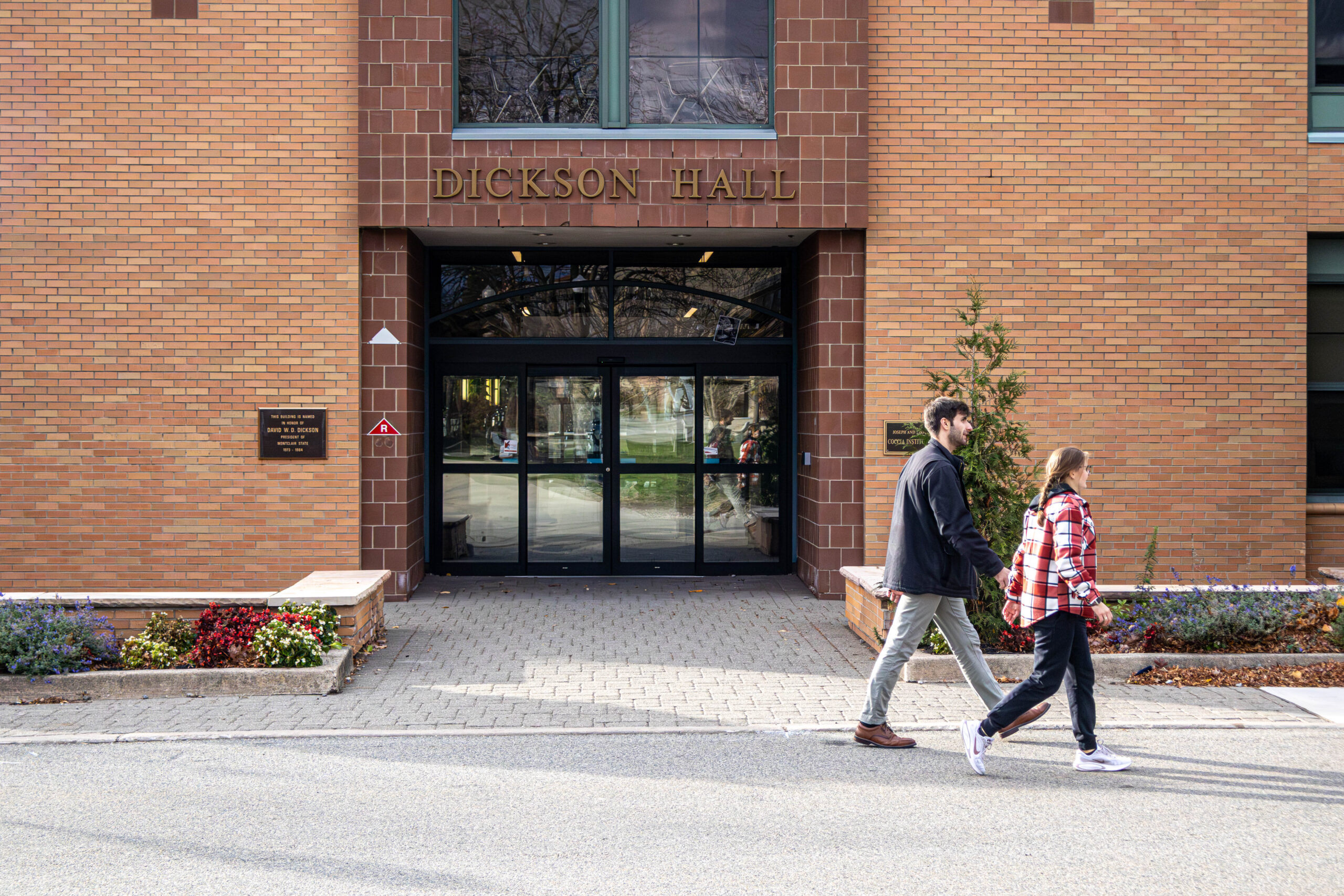
Students held a protest on Dec. 1 near Dickson Hall to challenge the university’s restructuring plan.
Despite the petition making rounds across the campus community and the protest occurring, the administration still plans on moving forward with the project. The administration’s goal is to have the CHSS restructured for the 26-27 academic year.