
Illustration by Camila Garcia
Benjamin Franklin once famously said, “In this world, nothing can be said to be certain except death and taxes. If Franklin were to come to Montclair State University, he would promptly add “parking trouble” to this aphorism. And he would find the complaint-prone topic is a far bigger lightning rod than the one he invented.
No weekday commuter or visitor needs reminding that university parking is a jungle. During the weekdays, copping a spot for your car feels like going on a safari. Motorists seemingly bushwalk through lot after lot for a high-premium space close to campus.
By now, I’m sure you believe this piece is going to posit a solution for campus parking. Instead, I am going to be bold and address the elephant in the room about Montclair State’s parking. Namely, that inventing a lasting solution for this scourge is far easier said than done.
Deeply-rooted conditions weave together to make university parking a real Gordian knot. To date, any effort to untangle the mess has proven Sisyphean. Truly, it would take a deus ex machina landing at Montclair State to rectify parking. On second thought, this deus ex machina would need a parking space for his chariot.
The first element of the parking problem is the university’s 2025 student population. It stands at approximately 25,000 as of fall 2025, with commuters accounting for around 75 percent of students. Thus, thousands of vehicles are repeatedly coming to and from both of Montclair’s campuses.
Indeed, it does not take a rocket scientist to note the correlation between commuter traffic volume and parking. But it will probably take a rocket scientist to crack the campus parking crunch. Anyone who thinks there is a simple answer is on the moon.
The second issue is the continuing rise in university enrollment. The number of attending students has expanded considerably over the decades. Meanwhile, the diameter of the roads surrounding campus has not. As proof, look at the habitual jam-ups on Clove Road.
Sometimes, afternoon traffic is bumper-to-bumper from the campus entrance all the way to the NJ Transit train trestle. Needless to say, Clove Road congestion is far worse than in my 1980s undergraduate French major days.
Thirdly, campus parking decks are not a long-term solution to the parking predicament. That is because they are very expensive to build, not to mention bringing more cars onto campus, and onto besieged byways. These multi-story buildings provide some parking relief until they fill up, which they do fast.
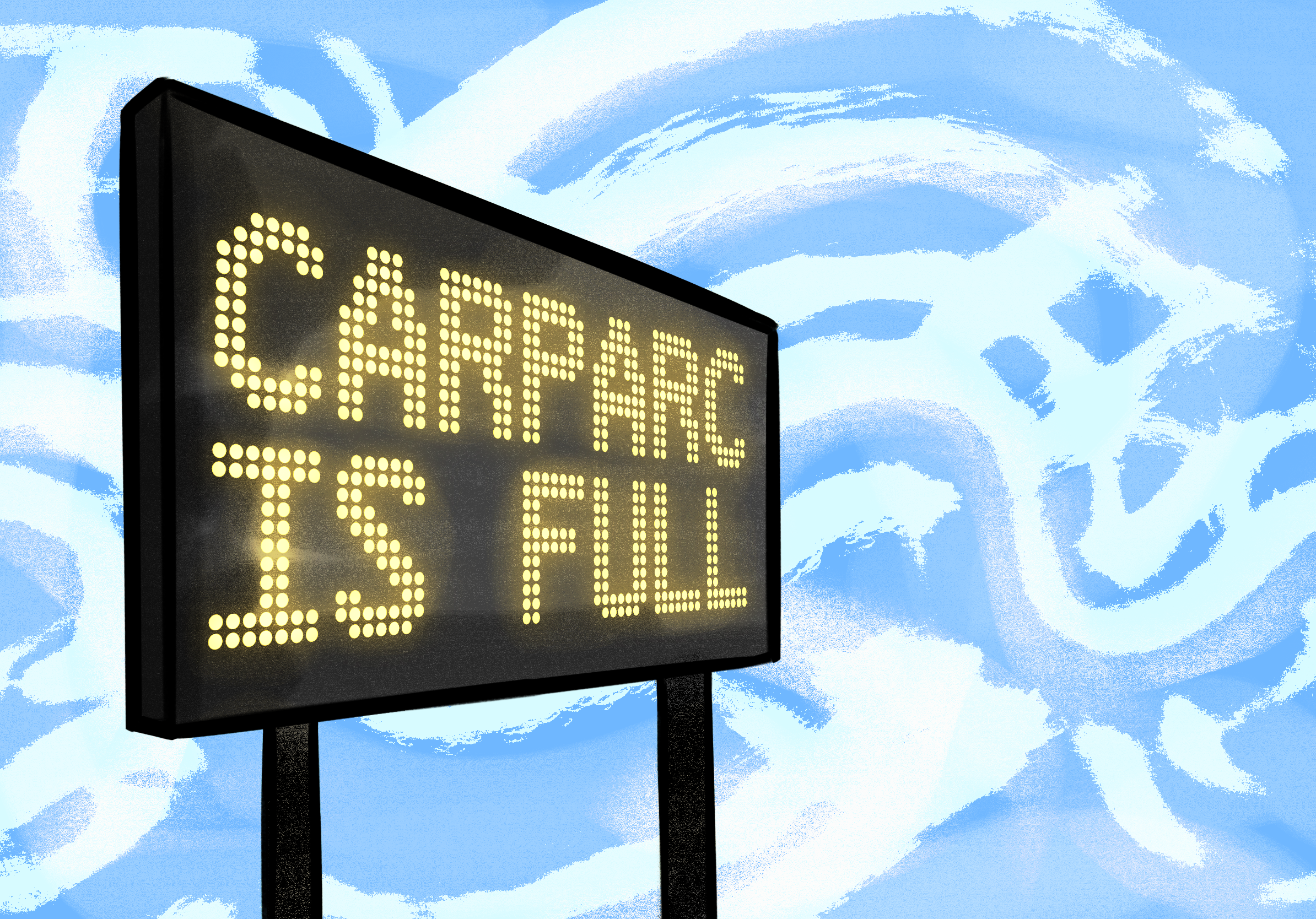
Car Parc Diem is a prime example. Countless times, I have been greeted at its entrance with an unwelcome electronic sign reading “Car Parc Diem is full. Please head to Lot 60.”
I feel compelled to divulge the brutal truth about Lot 60: there is a 60 percent chance of being forced to park there. It will take 60 minutes to get to class from there. And that will be the case for 60 years, unless a “60 Minutes” exposé prompts faster action.
The fourth facet regarding university parking is the American culture itself — people love to drive their cars everywhere. As a result, any new mass transit proposal to relieve parking pressure must vie with the automobile-centric nature of American infrastructure.
Everyone has heard the quintessentially American expression “Baseball, hot dogs, apple pie and Chevrolet.” This famous slogan summarizes the matter at hand. You see, finding parking is a new ballgame every time. It’s hardly easy as pie to snag a spot, which is the apple of every Chevrolet driver’s eye.
Now you see why the basic causes of the university’s parking difficulties are as ingrained as the aforesaid saying — and why an everlasting cure for this stubborn headache has remained and will remain elusive.
I witnessed that fact firsthand during an early October walk with university president Dr. Jonathan Koppell. This event was a combined campus stroll and question-and-answer session. It was attended by about 20 students, including me.
Koppell responded that the parking problem is tough to tackle for the very reasons I previously cited. The president then challenged his audience to come up with ideas. The only suggestions were more parking decks and, possibly, running shuttle buses to towns near the university.
I think that dialogue speaks volumes about conceiving a practical plan for ending parking troubles, even more than there are in the Sprague Library.