
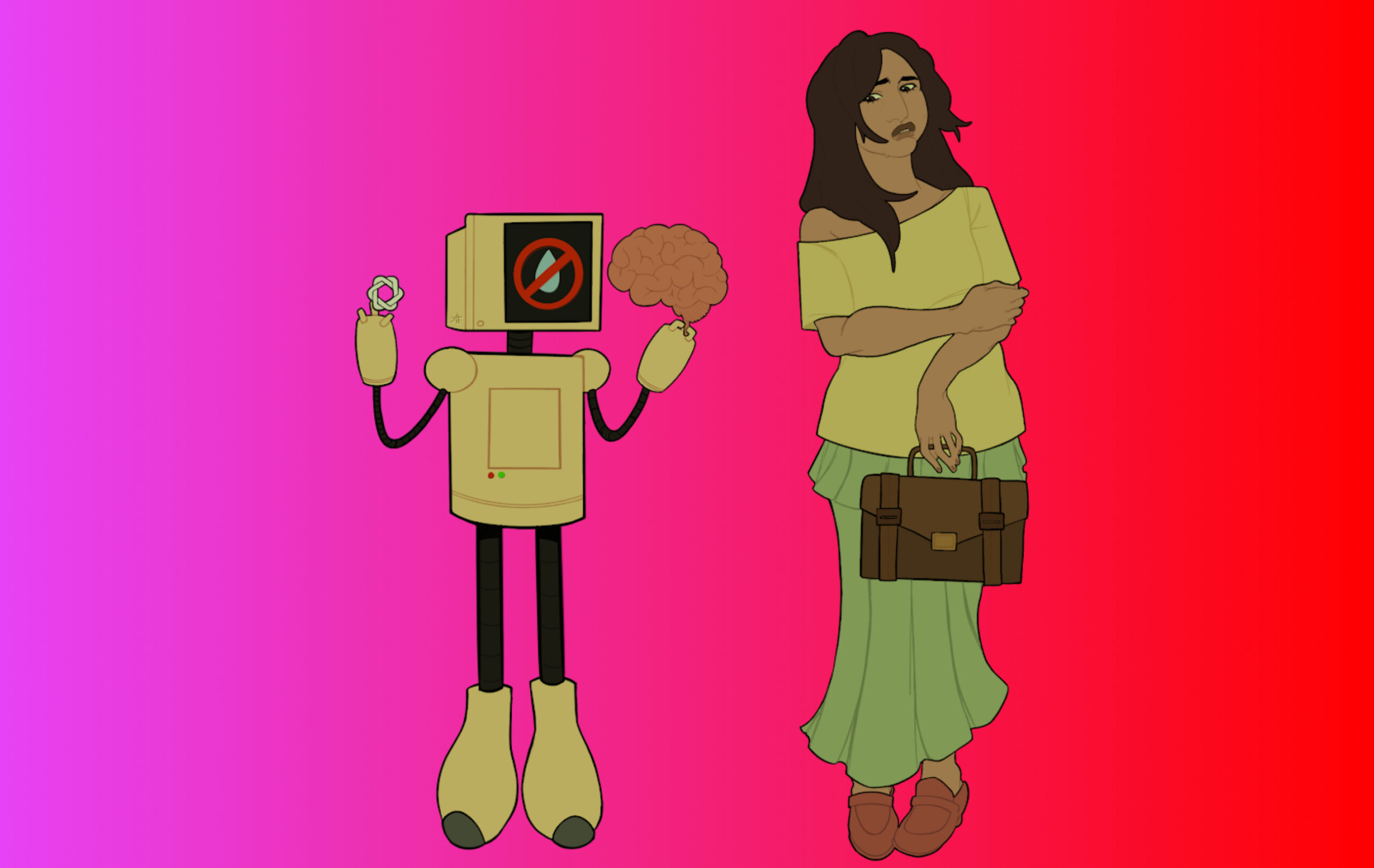
Illustration by Amani Bowie
Now listen, we’re not here to talk about plagiarism. As students, we understand the importance of writing in our own voices. Regardless, people continue to use ChatGPT, Gemini, and other AI models for countless tasks in their everyday lives. But you may be surprised to learn that this causes a significant amount of harm to the environment.
Just this January, climate change specialists partnered with Congress to release an analysis regarding AI data centers and their energy usage: The U.S. Department of Energy revealed that AI data centers account for 4.4% of total U.S. electricity use. Subsequently, they could account for more than 12% by 2028, according to projections (OE Blog 2026).
At a glance, 4.4% may not seem like a lot, but take into consideration the fact that our home state of New Jersey is only responsible for approximately 2% of total U.S. energy usage… that means our entire state collectively uses less electricity than the AI industry in the United States.
As students, we would like to emphasize that we’re not here to say that you shouldn’t use generative AI in its entirety. However, like many things in life, moderation and discretion may be key. While AI often seems invisible, tucked away inside our devices, its effects on the environment are far from it. In fact, the opposite is true.
AI models such as ChatGPT actually sap electricity and clean drinking water away from residential areas, specifically those that are already drought-sensitive. What, you may ask, does water have to do with AI data centers? The answer is that the millions of microchips that power these centers cause servers to overheat, and technology companies mitigate the high temperature of the hardware by using billions of gallons of freshwater to cool their systems.
This means that as millions of users interact with AI models every day, it exacerbates the problem and creates a significantly negative impact that many don’t recognize. As a matter of fact, according to the Environmental and Energy Study Institute, “Large data centers can consume up to 5 million gallons per day, equivalent to the water use of a town populated by 10,000 to 50,000 people” (Yanez-Barnuevo 2025). While many believe that water is in infinite supply because of the water cycle, the fact of the matter is that freshwater is an incredibly fragile resource (National Geographic).
On top of this, another issue to consider are the effects that AI models may have on our brains. While language-learning models are still a new technology, research has already been conducted to explore how AI affects our cognitive health; a small study from an MIT Media Lab explored this connection and found that relying too much on AI “may inadvertently contribute to cognitive atrophy” (Fluid Interface 2025). To continue thriving as a society, it is of vital importance to comprehend the value of our mental functions and contribute to activities that help develop these, rather than hinder them.
We hope that this information sparks an interest in long-term sustainability, and leads you to consider limiting your AI usage. If you’re interested in becoming more involved with sustainability on campus at Montclair State, please consider public service and volunteering. Participate in events hosted by the Office of Sustainability and the Montclair Campus Community Garden to become part of a revitalized, natural space on campus that provides fresh produce directly to students. You can also apply for the PSEG ISS Green Teams Internship, a paid program where undergraduates can address local sustainability issues.
As students, we understand how difficult it is to avoid AI models, especially when they seem to be embedded everywhere. For instance, even a simple Google search causes an AI model to appear on your screen. Yet, we should still look to the future and recognize our responsibility when it comes to long-term environmental sustainability not just for ourselves, but for the coming generations. We must act, and we can begin with our own practices on campus by limiting our dependability on AI usage and searching for eco-friendly solutions to our problems.