
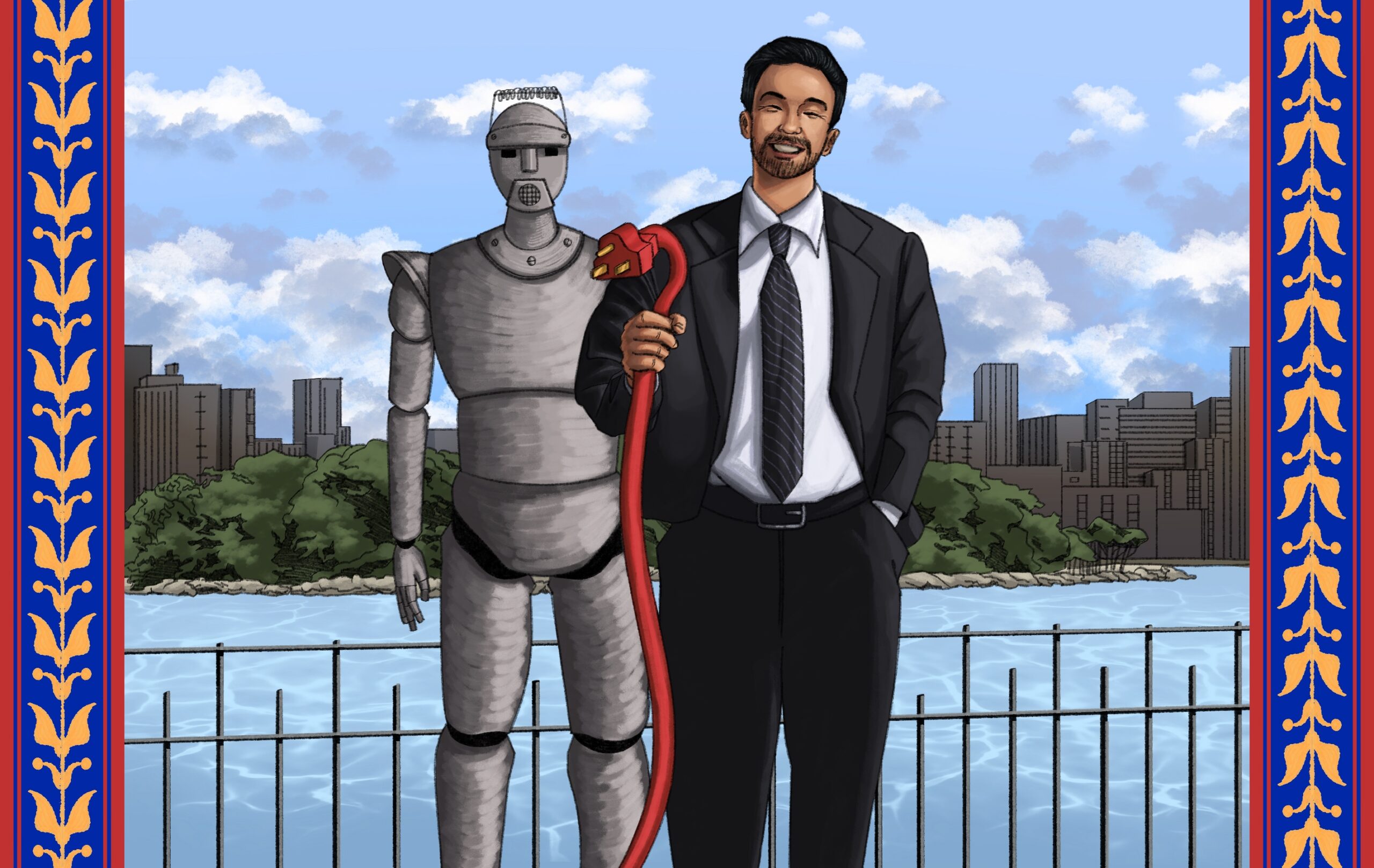
Illustration by Blake Marasigan
New Jersey’s sister state, New York, currently houses a widely beloved mayor in office, Mayor Zohran Kwame Mamdani. He is currently seen as the face for prioritizing children’s safety, enacting a highly influential, experimental ban on Artificial Intelligence (AI) I in K-12 programs. This is the first ban of its kind in the U.S., and it accounts for the recent backlash of media coverage and public opinion on the matter.
We have seen the running joke on social media associating fast fixes in the city with Mamdani or “New York’s Batman” that have occurred since his inauguration. All jokes aside, one “fix” that everyone is watching is addressing AI in schools. Given their mayor’s online reputation, it is no surprise that New York is the first to address this. But at the moment, there has been no sign of a potential ban for New Jersey schools or students.
The one-year moratorium is meant to prioritize AI literacy and critical thinking skills, and it includes two biannual AI literacy courses for students. Usage of AI is permissible only if a student provides a reason and receives a teacher’s approval.
This sort of thing may not affect all learners the exact same way, like students who attend university as adults. But what if those students take a position where they need to regulate AI sans state guidelines? This is what lingers in the back of the minds of students enrolled at Montclair State University to teach the arts and sciences.
Mariam Kamladze, an English junior undergraduate also minoring in creative writing, has enrolled with the university’s Teacher Education Program in hopes of becoming an English teacher. Interviewing her is a step towards answering the question that concerns New Jersey residents and future educators: “What if we had this exact ban in NJ public schools?”
Kamladze’s general thoughts are that the one-year lifespan of the New York policy helps put the brakes on our AI over-dependency but that the growth is beyond help. She last used AI for an introductory computer course at Montclair State where its tools were mandatory.
Kamladze acknowledges that not much is fully known about AI yet but says that like many others, she is is navigating it as best as possible.
“It’s a bit inevitable that students will be using AI in my classroom,” Kamladze said. “I have to implement my own guidelines. I think Quill will come into effect.”
“Quill” is the English supplement in the New York moratorium whose function is to highlight close readings. Kamladze is taking inspiration from this to possibly implement it in her class guidelines alongside Playlab, the final and fifth supplement in New York that stresses the identification of AI writing.
Given what we know at the moment, we may look towards the future to ask: how will AI in classrooms look tomorrow?
Dr. Jinxia He is an associate professor whose research concerns how AI impacts pre-existing educational concerns and creates new ones. One of their recent studies found that “…trust in AI positively predicts students’ AI reliance but negatively predicts AI literacy.”
While Kamladze did not know of the study until after the interview, both discussed strikingly similar ethical concerns: the qualitative results tie into the moral dilemma that stems from an overreliance on AI.
Kamladze’s thoughts echoed this, saying, “You shouldn’t rely on [AI] to do your entire work… you should use it as a tool, not as a replacement for you and your mind.”
Among the many qualms of AI and education, one surprisingly was not about being replaced by it.
“You’re not going to get these students’ attention at all,” Kamladze said. “Even if [AI] teaches the subject, it will not be able to regulate the classroom at all.” She brought up an amusing point, which is that tech giants fail to consider student management: “You could have kids throwing a bunch of stuff at it.”
Speaking about control, this brings us to a more generic yet true detail.
“How is AI supposed to be allowed to work in other fields, like cybersecurity,” Kamladze asked, “when it needs security itself?”
Many of us could relate to Kamladze’s stance on the appropriate extent of AI use when we consider the constant news reports declaring how AI companies are not able to “control” their product.
Despite what we have been saying so far, AI in every classroom is not the problem. There is a larger, lesser-spoken issue that is more prevalent — and it is something Kamladze identified during her shadowing hours at a Newark middle school.
“Some schools are underfunded,” Kamladze explained. “They didn’t even have enough computers for every single kid.”
The burning question of AI affecting education became a distraction from the current issue at hand:
“It’s a school where they’re barely getting by with [pen and] paper materials,” Kamladze said.
This is something to seriously consider when looking at AI: by introducing a deemed “fast solution” to long-term problems, we may actually worsen the issues we have or inadvertently create additional ones.
This is not a new story, but it is one that we are seeing develop at an accelerating rate. The facts we outlined here are as true and present for us as they are for those in education.
“I think the ban helps in putting the kids first,” Kamladze concluded.
Such a regulation in other sectors would ultimately mean putting humans first. And if you ask me, that is a textbook definition of how to actually ensure we are “augmenting human capabilities.”