Illustration by Blake Marasigan
A 64-year-old man — who, truth be told, was never known for having much charisma — has managed to bring the masses gathered at the Louisiana Superdome to the brink of ecstasy. His name is George Herbert Walker Bush.
After a political career that spanned everything from Congress to the Vice Presidency, with stints at the United Nations and the CIA along the way, he is experiencing the moment that will secure his place in history.
He is accepting the Republican Party’s nomination for the Presidency of the United States.
“No new taxes.”
Excitement fills the air. The man has pledged to continue the popular trend of deregulation and tax cuts implemented by the president under whom he serves, Ronald Reagan.
That formula will serve him so well that in the November election of 1988, he will defeat his Democratic rival, Michael Dukakis, 53.4% to 45.6%, and 426 electoral votes to 111. Remarkable!
However, the “no new taxes” pledge did not age well.
By October 1990, fiscal deficit and political maneuvering forced our friend Bush to raise taxes.
By November 1992, his electoral vote count had dropped from 426 to 168—far too few to prevent a young governor from Arkansas, unknown to many until recently—named Bill Clinton—from taking his place.
But why am I talking about all this?
I don’t think ninety percent of those still reading knew of George H.W. Bush’s existence until they started reading this article.
They probably do, however, know about his son, George W. Bush.
Nevertheless, besides severe FEMA irresponsiveness to Hurricane Katrina and 9/11’s provocation of “War on Terror” that traversed the Middle East, I do not think anyone remembers a signature domestic policy of Bush Jr. This is in contrast to the singular policy that ended his father’s presidency-tax cuts.
Initiated by Ronald Reagan, those tax cuts marked a return to a tradition: the priming of the business sector with tax breaks and benefits, in the hopes that the resulting prosperity would, to some extent, reach all sectors of society. This approach is also known as trickle-down economics.
As expert analysis would come to show, that did not happen.
In an attempt to spur an economic acceleration that never truly materialized, with George W. Bush’s tax cuts, we abandoned the path of fiscal discipline established in the late 1990s. Instead, we began fueling a seemingly-endless cycle of tax breaks that has increased the national debt and widened the gap between rich and poor.
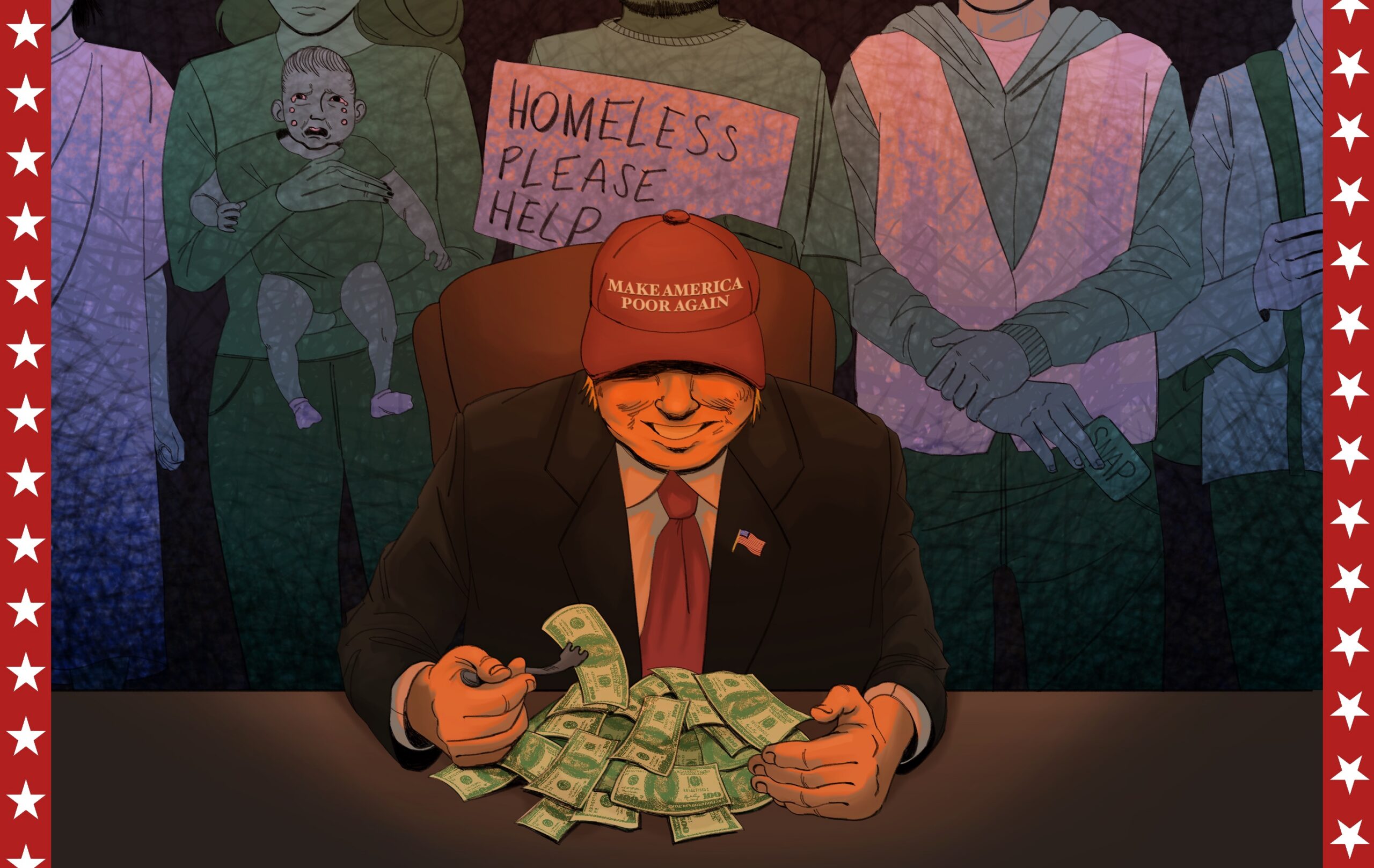
We saw an even worse law passed last summer. Like something out of a cheap comedy, it had a horribly grandiloquent name: the One Big Beautiful Bill Act (OBBBA).
Besides business tax cuts for the umpteenth time, it routed money to unproductive places. The bill increased spending on border defense and slashed key social programs like SNAP, among many other outrages. It all turned into a tangle of God knows how many pages that gave professional bill readers in Washington plenty of headaches.
We also see that its outcome — ironically, anything but a break for working class people — is bound to repeat itself.
Such a massive project meant that not everyone could grasp what was truly at stake. And unfortunately, one of the populations that picked up on this the least while having the most at stake was, and continues to be, university students.
The one that most people have mentioned is that federal loans for graduate students now have stricter limits and terms that make them extremely difficult to repay. But that is not all.
Most people still do not know what awaits us with the One Big Beautiful Bill’s consequences after the midterm elections. However, the outlook is enough to bring tears to many people’s eyes.
Among the consequences the law is expected to cause are a slowdown in economic growth, an unprecedented and sustained increase in federal budget deficits, the massive loss of health coverage and food assistance for millions of citizens, widening inequality between the rich and the poor, a potential budget crisis for state governments, and a halt to the limited progress made in this country regarding environmental preservation.
For university students, we will see consequences such as cuts to federal loan opportunities for graduate studies, greater reliance on private lenders, stricter repayment plans, taxes on universities, and further restrictions on Pell Grants (which were already modest to begin with).
For the majority of workers, things like the elimination of taxes on tips and social security pale in comparison to the losses they will face in the healthcare side.
So, in short, this administration’s star law is a disaster made with the intent of giving benefits to millionaires (something that never works) which we will pay for personally with ballooning deficits, cuts in public services, and a stagnant GDP growth.
To make matters worse, a carefully-calculated media strategy has been designed to keep us from realizing the full extent of what is happening. That is why it comes as no surprise to hear people racking their brains to come up with theories explaining current events rather than blaming this administration.
Perhaps that offers some consolation to those of us watching these changes with alarm. But if that is not the case — and if propaganda machines and algorithms aren’t the only things keeping us in the dark — then I believe we are facing a worst-case scenario.
That worst-case scenario is cowardice. We are all a bunch of cowards. We have forgotten the time Franklin Roosevelt said that the only thing we have to fear is fear itself. We are afraid to think outside the mental box we live in and to question whether the socioeconomic model we inhabit is the right one.
Are we afraid of the consequences? Or simply afraid to act?
Either option is a disgrace. And it is all the more disgraceful because, on the other side of the equation, there are people — devoid of fear or scruples — who possess the resources to fear nothing, not even the most powerful government.
Who are they?
The very same people who benefit from tax cuts.
They lie to us to line their pockets at our expense while we do nothing. And their pockets are so deep that ninety percent of those in Washington, D.C. don’t care about imposing fiscal policies that would never have crossed George H.W. Bush’s mind; they fear losing a donor more than they fear losing their base.
Yet, we do nothing. So, now, a little over a year after the One Big Beautiful Bill became a law, I ask myself:
Are we victims, or are we cowards?