
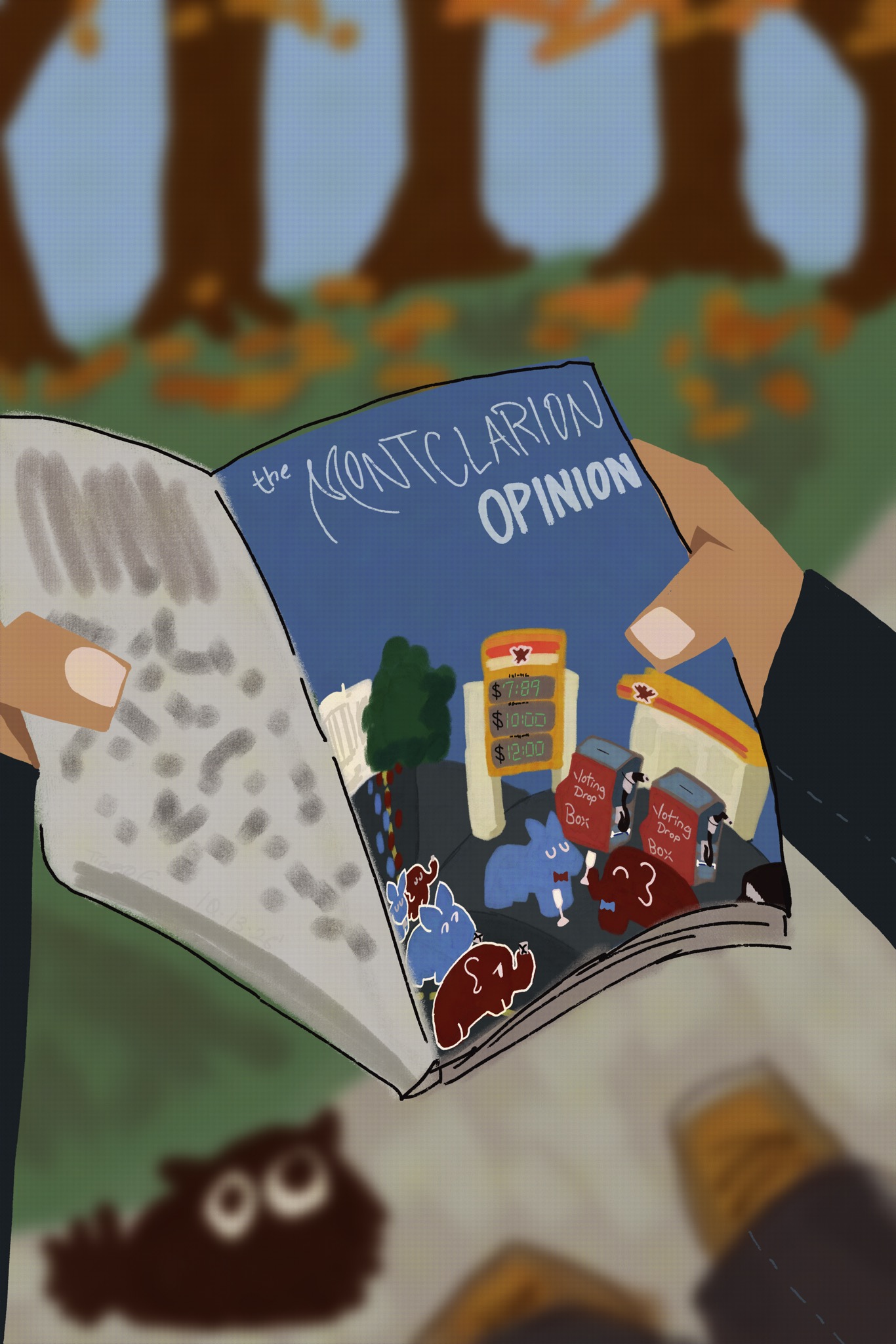
Illustration by Armani Tiago
For many Americans, especially college students inundated with hour-to-hour responsibilities, international politics can feel as distant as the countries where they are happening. At first glance, it is logical to feel that wars, foreign elections or humanitarian crises have little direct impact on someone’s daily life when they are, quite literally, happening thousands of miles away.
But when those events are filtered through our news, feeds and popular culture, that distance suddenly shrinks. And the more of this information we consume, the more we must ask: how much of what Americans believe about international events is shaped by the lens through which they learn of them?
A tragedy on home territory can inspire people to care about what goes on abroad. When the country is grieving, our approach to understanding undergoes a shift.
One such tragedy that still colors US media and our relationship with the world today is 9/11 and “The War on Terror” that followed. It’s no secret to anyone who’s purchased gasoline for their vehicle that the United States’ relationship with the Middle East is complicated.
The current tensions with Iran funnel back to the missed opportunities and covert conflicts that defined the post-9/11 era. Most of the students reading this — including the one writing it — were too young to remember this time. And despite that period feeling like it was so long ago, we now live in the shadows of past decisions.
Although Iran initially cooperated with the US to defeat the Taliban, this brief alliance was shattered by the 2002 ‘Axis of Evil’ declaration. What followed was not a conventional “boots-on-the-ground” war, but a decades-long “shadow conflict”.
By isolating Iran diplomatically and engaging in an invasion of Iraq, the US likely pushed Iran to expand its regional influence and accelerate its nuclear ambitions. Fast forward to today, and those same nuclear ambitions helped lead to the current Iran conflict.
For the average American, its significance does not necessarily reside in recounting an event’s timeline. It comes down to how those foreign policy decisions affect everything here, from privacy rights to pocket change.
We know that everyone is looking out for their wallets. Whether it’s groceries, healthcare, retirement savings or employment, international conflicts often disrupt trade markets. Despite politicians always emphasizing “America First”, we must hold accountable those who make decisions for abroad if we want to secure ourselves here at home.
So where is this “informing input” coming from? What is left out and whose voices have the most attention? These things influence how we understand an event before we ever seek out information through our own research.
No matter who you speak to — friends, coworkers, your aunt in the groupchat — social media is inevitably dividing our understanding of the world and also causing a generational divide among Americans. According to a study done by The Chicago Council on Global Affairs, 46% of Gen Z and 37% of millennials get their news from digital media (which includes YouTube and podcasts), whereas older generations tend to tune into broadcast networks and Fox News in particular.
Something that is independent of age is Americans’ difficulty in discerning the truth in US-sourced foreign news reporting: only 36% find its accuracy “easy” to determine! The confusion about the validity of international news, ironically, is what we see fostering Americans’ interest in domestic economics and news.
Today, audiences can compare domestic reporting with information from foreign news media and social media users. Global media includes journalists and firsthand accounts while also offering a new opportunity we did not have at our disposal to this extent. We can now contrast how the same event is reported and it makes sense to see how this contributes to the increasing skepticism toward American news organizations.
One thing is for certain: the way Americans consume international news is changing.
Information that reached audiences through timed mediums like newspapers, television, and established news websites now arrives through 24/7 platforms such as social media and direct messaging like WhatsApp. Even journalists find themselves relaying critical updates on such platforms, per a recent article from The Guardian outlining the ways that news-seekers and creators are utilizing it.
WhatsApp is an example of this double-edged sword in neo-journalism. Family group chats and social circles suggest validity because of who it comes from, yet that familiarity simultaneously makes group chats vulnerable to misinformation. WhatsApp has stepped in to address this by introducing limits on how frequently forwarded messages can be shared.
Social media can curate a perspective not even possible to be achieved by media outlets which respond to Federal Communications Commission (FCC) regulations. Companies like TikTok, Instagram, and YouTube may have guidelines, but governmental enforcement and oversight is lacking in many areas.
One example of this phenomenon is the Israel-Hamas war coverage. In addition to traditional news content, social media allows users to publish firsthand accounts with content more extreme in nature than televised images.
Bear in mind, easier access does not mean we are guaranteeing an increased exposure to “better quality” journalism. Unlike traditional news platforms, social media does not often require extensive fact-checking in the way a newspaper has as an editor or established journalistic standards.
At the moment, there is no streamlined standard for social media journalism. Meanwhile, we are battling the exponential spread of AI content that pulls from real material and repurposes it for a new presentation.
Amidst oversight concerns and discernibility, the gravitation toward news outlets besides American-sourced ones continues, and for immigrant communities, this yields something in particular.
Their preferred sources present information in a way that American outlets do not always provide. A 2026 study of immigrants in the Netherlands found that immigrant citizens intentionally sought out news from their motherland due to cultural identity, relevant political events affecting family and ease of comprehension via their native tongue. While the study was conducted in the Netherlands, its findings offer a framework for understanding the similar trend we see here.
The need for culturally rooted news is also reflected in our own state. The New Jersey Civic Information Consortium supports efforts to tailor local news and civic information toward the state’s immigrant communities. In short, we are witnessing how news delivery is not only a national issue, but a local one as well.
Putting action to input means voting for a candidate whose international policies and positions are understood, not only their stance on domestic policies.
Senators help shape the US through their votes on legislation and funding that spans well beyond Washington. With the midterm elections approaching, students like you and I have an opportunity to make our voices heard by looking at the ballot more closely.
We have come to realize that shaping our future means shaping not only our country, but our relationship with the rest of the world.
Senate elections take place on Tuesday, Nov. 3.